
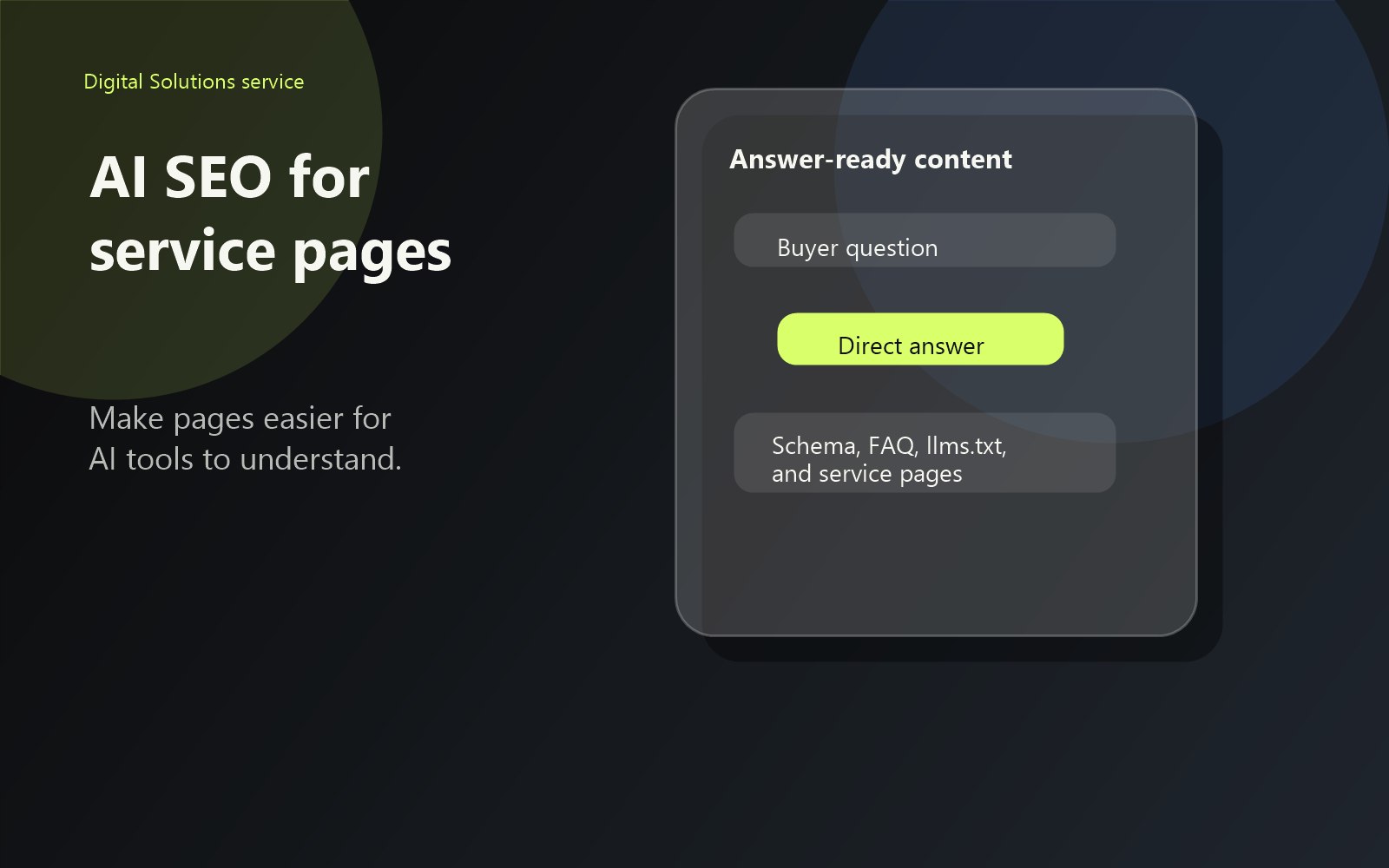
Most websites were built for old search habits.
A normal website might look good but still be hard for AI systems to understand. The services may be vague, FAQs may not answer real buyer questions, pages may not be structured clearly, and important files like sitemap.xml, robots.txt, llms.txt, llms-full.txt, or index.md may be missing.
If AI systems cannot extract clear answers from the website, the business is less likely to be cited, summarized, or recommended when customers ask AI tools for help.
We guide the setup so the automation fits the way your business actually works.
Digital Solutions maps your current enquiry flow, writes the customer questions, builds the automation, and tests the handoff before it goes live.
- Map the journeyWe review how leads arrive, what customers ask, and where follow-up slows down.
- Build the systemWe create the assistant, flow, messages, integrations, and human handoff rules.
- Launch and improveWe test the workflow, check the customer experience, and adjust the system after real use.
AI SEO makes your service information easier to extract and cite.
Digital Solutions creates service pages, buyer-intent FAQs, schema markup, clean markdown mirrors, sitemap updates, robots guidance, and AI-readable files that explain what the business does in a clear structure.
The goal is to help both humans and AI systems understand who the service is for, what problem it solves, how it works, what questions buyers ask, and how to contact the business.
AI visibility is becoming part of the sales funnel.
If a customer asks an AI assistant “Who builds WhatsApp AI automation for small businesses in Australia?” or “How can I automate quotes for my trade business?”, the websites with clear service pages, FAQs, schema, and machine-readable summaries have a better chance of being understood. AI SEO is not a magic ranking trick. It is a structured content system for the way people search now.
- Service pages answer specific buyer queries
- FAQ schema and clean markdown improve extractability
- llms.txt, llms-full.txt, index.md, sitemap.xml, and robots.txt help AI crawlers understand the site
How AI SEO turns service content into answer-ready pages.
The AI SEO process turns vague website content into clear, structured, answer-ready information.
- Audit the current website, service pages, FAQs, and entity signals
- Create or rewrite service pages around real buyer questions
- Add FAQ schema, service schema, sitemap entries, robots.txt, llms.txt, llms-full.txt, and index.md
- Improve internal links and plain-language service summaries
- Refresh content as services, examples, and search behavior change
What is included in this setup?
Every setup is shaped around your current workflow, your customer questions, and the way your team wants to handle the final response.
- Buyer-intent service page structure
- Direct answer blocks and FAQs
- Service and FAQ schema notes
- Sitemap, robots, llms.txt, and index.md review
- Internal link recommendations
- Refresh plan for changing search behavior
Business types this can help.
- local service businesses
- consultants and coaches
- clinics and allied health
- real estate and property services
- restaurants and venues
- agencies and professional services
This is a good fit if...
- Your service pages are vague or thin
- You want content that AI tools can understand and cite
- You need stronger FAQs, schema, and internal links
This may not be the right fit if...
- You expect AI SEO to be a one-click ranking trick
- You do not want to explain your services clearly
- You cannot review or refresh content as your offer changes